
Case Study: 3-Week Post-Operative Massage Therapy Management Following Right Total Knee Arthroplasty (Weeks 6–8)
1. Client Overview & Initial Presentation (Week 1 | 6 Weeks Post-Op)
Background: The client presented 6 weeks post-op following a right Total Knee Arthroplasty (TKA) performed via the Jiffy method (medial incision), with a recent history of cholecystectomy.
Subjective Intake: Denied resting pain, but experienced severe post-PT pain flares lasting up to 72 hours that limited daily activity, alongside walking-induced swelling (lowest upon waking). Cold therapy and compression stockings provided minimal relief for the fluid accumulation.
Client Goals: Reduce post-PT swelling and ease incision-site tightness to improve tolerance for physical therapy.
Initial Objective Findings:
ROM: 120° smooth passive knee flexion.
Edema & Observation: Light-to-moderate anterior warmth; moderate-to-severe periarticular edema; moderate fluid retention at the right inguinal region exacerbated by mechanical compression ("ligature effect") from tight underwear elastic.
Palpation: Moderate myofascial restrictions and moderate-to-severe tenderness along and beneath the medial incision (vastus medialis obliquus [VMO] region).
Initial Clinical Impression: Post-surgical fluid stagnation compounded by proximal mechanical compression, paired with localized myofascial and scar tissue restrictions around the medial incision and VMO.
2. Three-Week Treatment Progression
In alignment with our knowledge base, treatment progressed from an Initial Phase (decreasing threat, clearing fluid, and educating on pacing) toward a Progression Phase (supporting tissue remodeling, regional mobility, and return to functional activities).
Week 1 (11/9/26 | 6 Weeks Post-Op): Decongestion & Threat Reduction
Intervention: Initiated Manual Lymphatic Drainage (MLD) proximally at central and right inguinal pathways before addressing distal periarticular edema. Followed with gentle Myofascial Release (MFR) around and beneath the medial surgical scar.
Immediate Response: Visible and palpable softening of periarticular edema and improved local tissue compliance.
Education & Home Care: Advised switching to loose, non-binding undergarments to remove inguinal constriction; introduced proximal self-brushing and leg elevation above heart level; and educated on pacing PT exercises within pain-free tolerance to avoid triggering 72-hour nervous system flares.
Week 2 (11/16/26 | 7 Weeks Post-Op): Tissue Mobilization & Quad Engagement
Interval Changes: Discontinued the ice machine, paused PT for the week, and reported significantly reduced swelling and pain. Client was ascending/descending stairs normally and increasing household activity (noting she was occasionally pushing past her pacing boundary).
Objective Changes: Markedly reduced periarticular edema and complete resolution of right inguinal fluid backup. Persistent "stickiness" and tightness noted around the incision and peripatellar region; PROM remained smooth and of good quality.
Intervention: Soft Tissue Manipulation (STM) around the incision (within tolerance), peripatellar region, and quadriceps femoris, finishing with MLD.
Immediate Response: Reduced pain during active range of motion (AROM) on the table post-treatment, with noticeably improved quadriceps and VMO engagement.
Week 3 (11/24/26 | 8 Weeks Post-Op): Scar Remodeling & Functional Return
Interval Changes: Returned to PT (1x/week). Achieved major functional milestones, including her longest solo drive safely, sleeping comfortably on both sides, and navigating stairs normally (with only a slight compensatory turn). Physician Assistant (PA) measured knee flexion at 128° (+8° improvement over 2 weeks). Remaining pain (6/10) was isolated to a sensation of joint fullness and discomfort directly under the incision.
Objective Changes: Mild, normal edema and mild gait compensation. Proximal rectus femoris fascial hold provoked moderate+ sensitivity at the incision, whereas transverse holds on either side of the incision were pain-free. Point tenderness noted at the incision (moderate+) and peripatellar region (light+).
Intervention: MFR and STM of the quadriceps femoris, targeted scar tissue work around the incision, and friction therapy in the peripatellar region.
Immediate Response: Initial discomfort with PROM post-treatment resolved completely with repeated flexion.
3. Biopsychosocial (BPS) Clinical Synthesis
Applying the Biopsychosocial framework from our knowledge base highlights how each domain contributed to this client's upward trajectory:
Biological: Eliminating proximal mechanical restriction and sequencing MLD from proximal-to-distal cleared the right inguinal backup by Week 2. Progressive STM, MFR, and peripatellar friction therapy supported scar remodeling, reduced joint capsule tension, improved VMO engagement, and corresponded with an 8° increase in knee flexion (120° to 128°).
Psychological: Early education on pacing helped break the cycle of 72-hour post-PT pain flares, shifting the client from managing reactive pain to building confidence in her movement—evidenced by solo driving, comfortable side-sleeping, and setting a goal to return to the gym.
Social & Functional: Resuming normal stair navigation, household tasks, independent driving, and coordinated 1x/week PT and massage sessions demonstrates strong integration back into daily life.
4. Outcomes Summary & Future Plan
Measurable Outcomes (Week 1 to Week 3):
PROM Flexion: 120° → 128° (per PA measurement).
Edema: Moderate-to-severe periarticular edema with inguinal backup → Mild, stage-appropriate edema with clear proximal pathways.
Function: Severe 72-hour post-PT activity limitation → Normal stairs, solo driving, pain-free side-sleeping, and preparing for gym return.
Ongoing Plan: Continue weekly massage therapy coordinated with weekly PT to support soft tissue remodeling around the medial incision and quadriceps as the client transitions back into gym activities within the next week. Continue monitoring tissue irritability and reinforcing activity pacing as load increases.
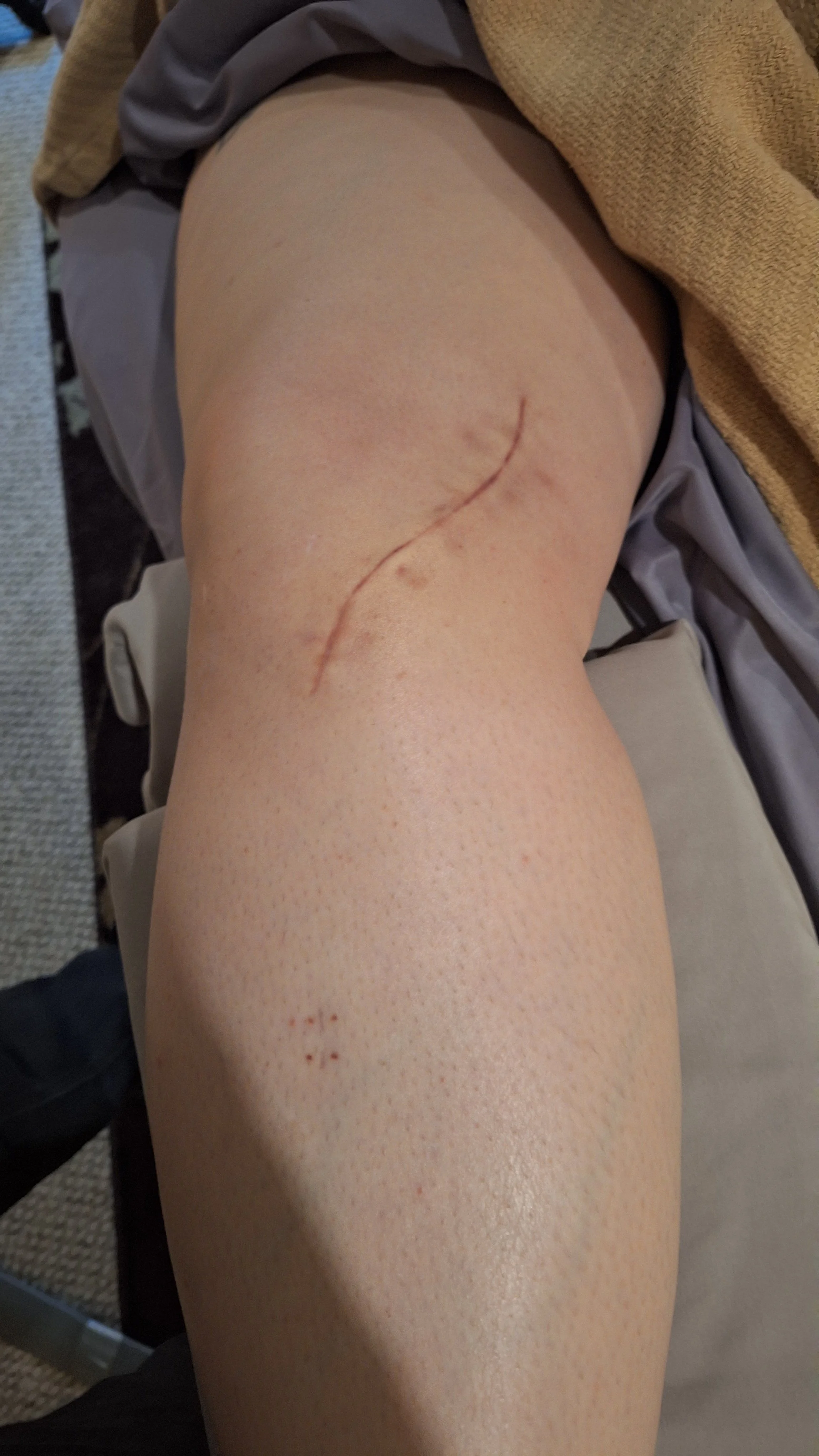
Incision from Jiffy Knee style of knee replacement. While the incision lies medial compared to most knee replacement incisions, the procedure itself is still a total knee replacement, or Total Knee Arthroplasty.